
Happy “Chrismukkah”
The church we attend has an annual Christmas Sweater Sunday. Everyone is encouraged to wear a favorite Christmas outfit, or “ugly” Christmas sweater. It is quite a sight… especially for a Jewish guy from NYC – me!
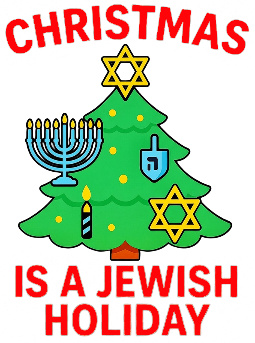
Wanting to join the fun – but make a point – I scoured the web for a “Christmas is a Jewish Holiday!” sweatshirt with a graphic blending Christmas and Hanukkah images. After finding nothing, I came up with this image with some help from AI and two friends.
My point in connecting the holidays arises from Yeshua’s (Jesus’) teaching in John 10:22 and following verses. John introduces this section by telling us specifically when and where Jesus was: “At that time the Feast of the Dedication (Hanukkah means ‘dedication’) took place at Jerusalem; it was winter, and Jesus was walking in the temple in the portico of Solomon.”
Here is the connection: the One whose birth we celebrate at Christmas is the One who meets the greater need to which Hanukkah points.
The background of this feast and its location provide critical insight into Yeshua’s teaching. Historically, Hanukkah commemorates the Jewish people’s victory (circa 165 BC) over the occupying forces of the Syrian king, Antiochus IV Epiphanes, as recorded in the apocryphal book of 1 Maccabees. To maintain control over Israel, Antiochus tried legislating Jewish identity out of existence by outlawing circumcision and Torah study. Additionally, his army seized control of Jerusalem and its Temple, which he desecrated by erecting the statue of a Greek god in it… even sacrificing a pig on its altar!
The Maccabees, a family of devout Levitical priests, mustered a rebel force to defeat Antiochus and stop his eradication of the Jewish nation through assimilation. After a two-year struggle, the Maccabees drove the invaders out of the Temple, cleansed it, and restored the worship of Israel’s God. It was a miraculous military victory because the Maccabees were totally outnumbered and “out gunned.”
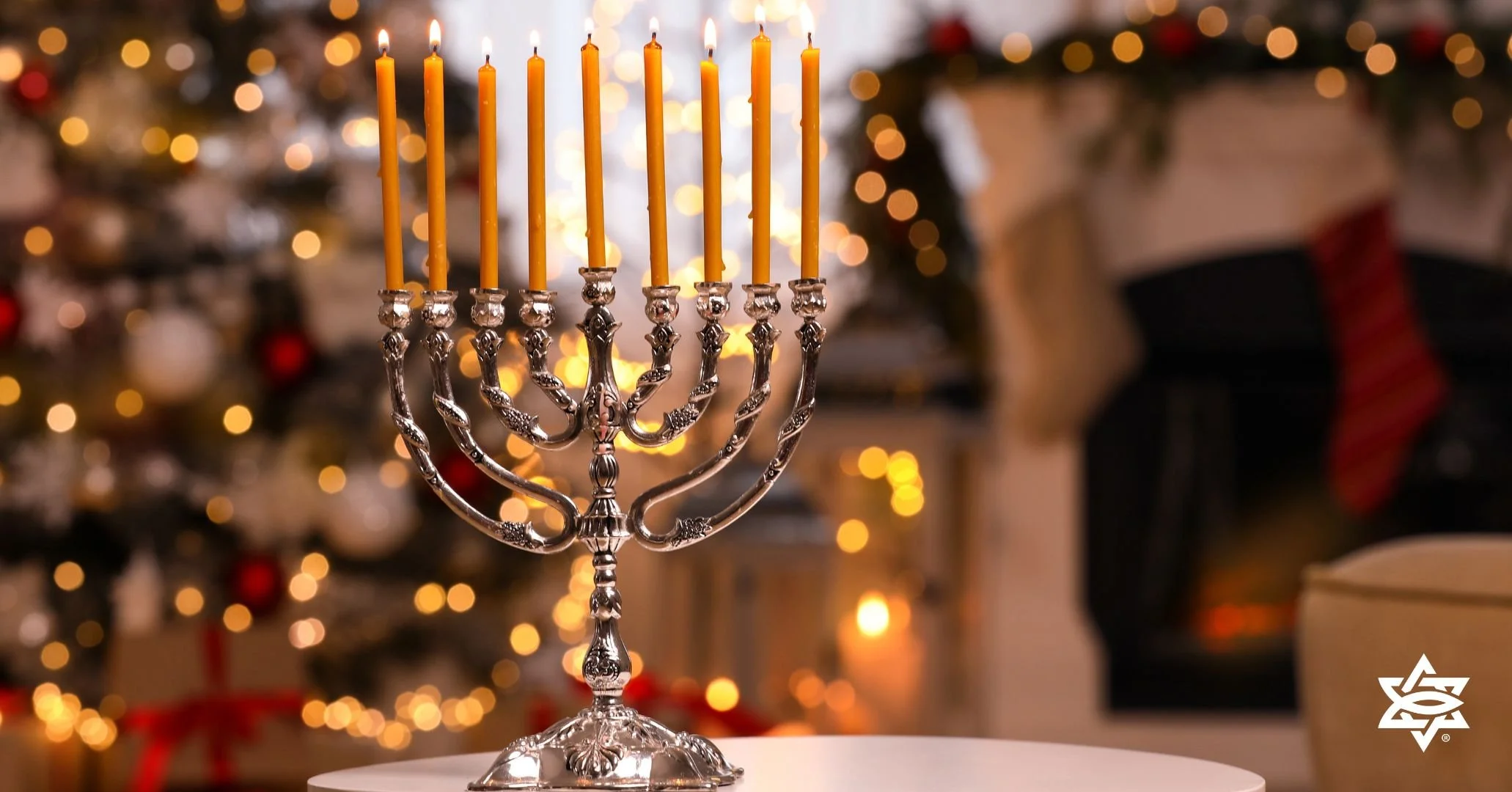
Since that time, the Maccabee victory has been celebrated at Hanukkah, the Feast of Dedication. It begins at sundown on the 25th day of the ninth Hebrew month, Chislev (November/December in our calendar), and lasts eight days. A later Jewish tradition ties the duration of the holiday to a “miracle” in which a one-day supply of sanctified oil for the Temple’s menorah (seven-branch candelabra) lasted the entire eight days required for preparing new sanctified oil.
These “miracles” are commemorated by lighting a menorah, a nine-candle candelabra (one servant candle that is used to light one additional candle each of the eight days), eating food cooked in oil, and playing games with a small four-sided top called a dreidel. Each side of the dreidel bears a Hebrew letter: nun, gimel, hay and shem, which stands for, “Nes gadol hayah sham,” translating to: “A great miracle happened there.”
John mentions this historical context in John 10:22 because the land of Israel and its capitol, Jerusalem, was once again under foreign pagan control by Rome.
In Yeshua’s day, the Romans permitted Jews to worship as they desired, but they were hypervigilant against any hints of Jewish sedition or revolt against Caesar’s authority. Rome did not defile the Temple as Antiochus IV had, but they stationed a very “un-kosher” Roman garrison at the Temple’s northwest corner in the Antonia Fortress. So… in John chapter 10 when the Jewish leadership surrounds Yeshua and demands, “How long will You keep us in suspense? If You are the Messiah, tell us plainly,” they are not seeking esoteric theological insight.
The Jewish people (including Yeshua’s disciples) expected a king-like Messiah who would vanquish their pagan Gentile overlords, free Israel, and restore political sovereignty by establishing God’s kingdom. In their thinking, this was Israel’s primary need. Yeshua’s response to the Jewish leadership’s demands challenges this assumption by pointing to a far greater need.
First, Yeshua cites His miracles as ample proof of His Messiahship (John 10:25). Then, He confronts the leaders with their unbelieving alienation from God as the reason they cannot recognize Him (vv. 26–28). But Yeshua really shocks them by saying: “I and the Father are one” (v. 30). The leaders immediately recognize this as a claim to deity and accused Yeshua of blasphemy (vv. 31–33).
Why would Yeshua choose this moment of tension with the Jewish leadership to boldly affirm His deity? Because His Jewish people were celebrating the Maccabees’ victory over the Syrians while Israel and the Temple were once more under foreign domination. As they celebrated in the Temple – with their pagan Roman overlords in sight – they must have been yearning for what they thought they needed: a Maccabee-like messiah who would vanquish their enemies and restore sovereignty to Israel.
The leaders are asking, “Are you this Messiah?”
By affirming His deity Yeshua is saying, “I am the Messiah, but able to meet a much bigger need.”
Ironically, the Maccabees’ victory itself is proof of this greater need because ultimately, they failed. A few generations later, their leadership was corrupt, their nation was torn by a civil war, and eventually it succumbed to Roman occupation. Why? Because more than political and military leaders were needed. The Jewish people needed God Himself to deliver them from their sin-hardened hearts. Only once they were transformed from the inside out would God establish Messiah’s kingdom rule among them.[1]
Here is the connection again and what makes Christmas a Jewish holiday: The One whose birth we celebrate at Christmas is the One who meets the greater need to which Hanukkah points.
So… this is why I want to wear a “Christmas is a Jewish Holiday” sweatshirt. My Jewish people need to know that the One whose birth their Christian friends and neighbors are celebrating is their Jewish Messiah, God’s provision for meeting our greatest need. This is especially true as antisemitism flourishes around the world.
I like to remind my Christian brothers and sisters that the gospel “…is the power of God for salvation to everyone who believes, to the Jew first and also to the Greek” (Romans 1:16). Every blessing that flows to us from Yeshua’s birth is ours because God is fulfilling His promises to His Jewish people. All of us who know Messiah can point to ourselves and say “Nes gadol hayah po” – “A great miracle happened here.”
Remembering the Jewishness of Christmas in this way fosters gratitude toward God and a love for His Jewish people. May this gratitude overflow in us humbly – yet confidently – sharing Messiah’s Good News “to the Jew first and also to the Greek.”
Written by Dan, Life in Messiah Board Member
How might remembering the Jewishness of Christmas cultivate deeper gratitude and humility in you? Is there a way you can incorporate the Jewish background of Christmas into your family’s celebrations this year?
Where might God be giving you opportunities to gently and humbly share Messiah’s Good News – especially with Jewish friends or neighbors?
What practical steps could you take to “remember the Jew first” (Romans 1:16) in your prayers, giving, or relationships? If you haven’t already, we would love to invite you to subscribe to receive our weekly updates of “God at work” stories and prayer requests from our staff around the world. This encouraging and edifying update also includes blogs, videos, podcasts, and resources for how to share God’s heart for (and with!) the Jewish people.
Endnotes:
[1] See Deuteronomy 30:6; Jeremiah 31:31&ff; Ezekiel 11:19; Ezekiel 36-37; et al.