
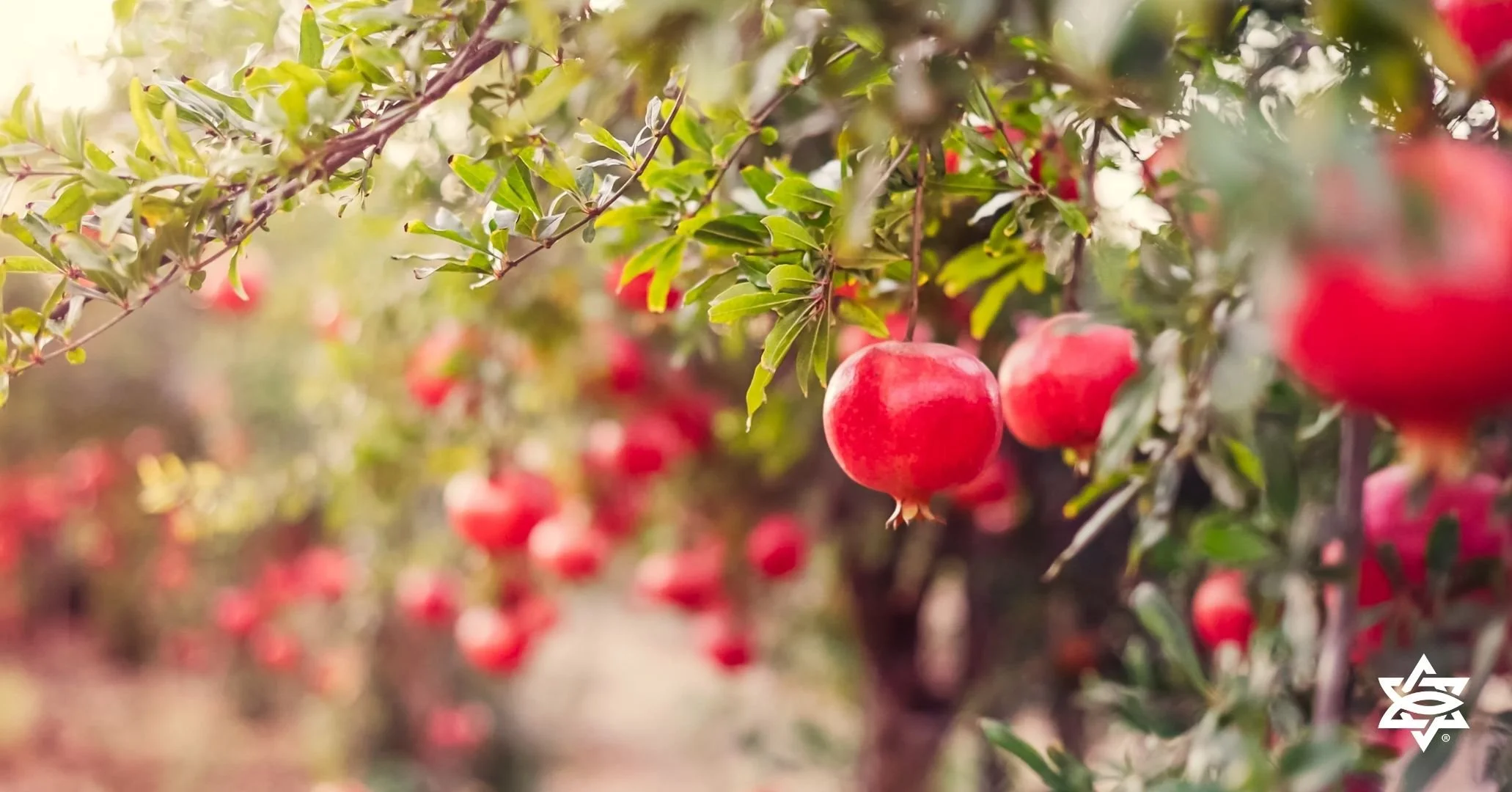
“Sappy New Year” might be a nice greeting for the trees on the Jewish holiday, Tu B’Shevat. Every year around this time, the Jewish community marks its “new year for the trees” on the 15th of the Hebrew month Shevat.[1] This holiday is considered a minor holiday in Jewish culture and marks the start of the agriculture cycle in Israel.[2]
Although Tu B’Shevat is often referred to as the “new year for the trees,” some Jewish authorities argue that “new year for fruit” (rather than for trees) is a more accurate term. This is because fruit that began developing before Tu B’Shevat is counted as part of the prior agricultural year, whereas fruit that develops after Tu B’Shevat belongs to the new one.[3]
Today in Israel, Tu B’Shevat carries with it an ecological responsibility to care for the land and agriculture in Israel. Traditionally, as on Arbor Day in the United States, trees are often planted in Israel and by Jewish communities around the world.
Within the pages of the Scriptures, both trees and fruit play significant roles – appearing in events and celebrations, and serving as analogies and images within biblical typology.
In Genesis, the very first book of the Bible, two very important trees are placed within the garden of Eden – the “tree of life” and the “tree of the knowledge of good and evil.”[4] The result of disobedience to the commandment given by God to Adam and Eve regarding these trees introduced sin to humanity and ultimately set in motion a plan to reconcile the broken relationship with God. Sin would now be passed on to all people, and access to “the tree of life” would need to come through a Redeemer.
Trees such as the cedar, myrtle, fig, cypress, olive, palm, and others are used as symbols in the pages of our sacred text. Psalm 1 speaks of a blessed man who is like a tree planted by streams of water, yielding its fruit in season because He walks in the way of the LORD. In the Tanakh (Old Testament) “the righteous” are symbolized as green trees. A green tree symbolizes life, renewal, abundance, and peace…something that bears fruit. In contrast, a dry tree in Scripture often symbolizes people who are disobedient and wicked.[5]
In the Gospel of John, Nathanael became a disciple after Jesus revealed supernatural knowledge (and omnipresence) by saying He saw Nathanael under the fig tree.[6] In Luke, a tax collector of ill reputation (and short stature), climbed a sycamore tree to see Jesus. Jesus called him by name to come down, for Jesus intended to visit his house – which He did, resulting in salvation for Zaccheus and his family.[7]
These are just a few of many examples. Trees certainly have their place in the Bible! However, Jesus gave a warning over 2,000 years ago on His way to be crucified, one which everyone needs to take seriously. Jesus said these words to a multitude of people following Him and a group of weeping women, knowing soon He would suffer a cruel death:
“Daughters of Jerusalem, stop weeping for Me, but weep for yourselves and for your children. For behold, days are coming when they will say, ‘Blessed are those who cannot bear, and the wombs that have not given birth, and the breasts that have not nursed.’ Then they will begin to say to the mountains, fall on us,’ and to the hills, ‘cover us.’[8] For if they do these things when the tree is green, what will happen when it is dry?” (Luke 23:28-31)
Jesus’ use of the term “green tree” and “dry tree” was meant to convey this: if this is what happens to the Righteous One, then pity yourselves because judgment – both physical upon Israel and spiritual upon all those who are not righteous – is surely coming.
In the Torah, for some crimes worthy of death, a convicted person’s corpse was hanged on a tree and they were considered accursed.[9] Centuries later, the Apostle Paul in a letter written to the church in Galatia wrote that the death of Jesus by crucifixion on a wooden cross was so that He might redeem both the people of Israel and Gentiles from the curse of the Law. By His becoming “the cursed one” in our place as a required sacrifice for sin, we are able to receive the promise of blessing with Abraham through faith in Jesus.[10]
A “new year holiday” for the trees and recognizing the importance of trees in our ecological system (and for life and humanity in general) is a wonderful tradition. However, the most important thing a person must consider is their spiritual standing (“green” or “dry”) before a holy God and one’s eternal destination.
So, as we enter the new year for trees, a time of growth and renewal, remember that the deepest growth your soul longs for can only be found in Jesus. If you are uncertain of your eternal future and know there is something more – something greater than just your physical life or religion – and have found that spirituality, beliefs, or even people do not fulfill the deep longing of your soul, please contact us. Whether you are Jewish or not, the answer is the same and is found in the Son of God who was put to death by hanging on a tree.[11] You can have access to the Tree of Life forever – for Messiah Jesus is the Way, the Truth, and the Life and no one comes to the Father but through Him.[12]
Written by Jeff, Life in Messiah Staff
What areas of your life feel dry or in need of renewal, and how could God bring growth there?
Does understanding Jesus’ death “on a tree” change the way you see the Old Testament imagery of trees and curses? If so, how?
As Tu B’Shevat marks a time of planting and renewal, what “seeds” might you consider planting this year to produce fruit for God’s glory in our day?
Endnotes:
[1] Hebrew language insights:
Hebrew words may be variously transliterated into English; because the “e” in Shevat is the lightly vocalized “schwa” sound we learned in grammar school, it is pronounced “sh’vat” and sometimes spelled Shvat;
Single-letter prepositions are added to the beginning of a word; the letter “bet” (“beit”) means “in”; B’Shevat (or BiShvat) means “in (the month of” Shevat);
Hebrew letters have a numeric value; for example, “yod”(י) = ten; “gimel” (ג) = three, so 13 is written י״ג, with the ״ symbol separating the letters. One would presume using this system that 14 would be “yod heh” (י״ה) and 15 “yod vav” (י״ו), but because the four letters of God’s “inexpressible name” are יהוה, 14 is written “tet heh” (ט״ה or 9+5) and 15 “tet vav” (ט״ו) is 9+6. [Why “tet vav” is vocalized as Tu is another lesson….]
[2] https://www.myjewishlearning.com/article/tu-bishvat-ideas-beliefs/.
[3] Quoted from the following article: https://aish.com/abcs-of-tu-bshvat.
[4] Genesis 2:9.
[5] One example can be found in Ezekiel 20:47.
[6] John 1: 43-51.
[7] Luke 19:1-10.
[8] Hosea 10:8.
[9] Deuteronomy 21:22-23.
[10] Galatians 3:10-14.
[11] Acts 10:39,13:29.
[12] John 14:6.