

Hope in Chaos: Why Biblical Prophecy Matters Today

If you've glanced at the headlines lately, you know the word chaos isn't an overstatement.
Economic uncertainty, dangerous illnesses, ongoing conflicts in the Middle East, and growing instability around the world leave many people wondering what comes next. Fear and confusion seem to be the natural response.
Yet in the midst of that uncertainty, God has given us something to anchor our faith: biblical prophecy.
Unfortunately, prophecy is often either ignored or misunderstood. Some associate it with sensational predictions, date-setting, or theological arguments, while others dismiss it as impractical or irrelevant to everyday life. But Scripture presents prophecy very differently. Rather than leading us into fear, God designed it to strengthen our confidence in Him, remind us that He is in control, and fill us with hope for the future.
Why study biblical prophecy?
Many believers are hesitant to study prophecy. Common objections include:
"Doesn't prophecy just cause division?"
"Doesn't it lead people into speculation and date-setting?"
"No one can really know what's going to happen anyway."
"I'd rather just live for today and let everything work itself out."
While these concerns and objections are understandable, they overlook an important fact: prophecy makes up a significant portion of God's Word.
Bible teacher Dr. Mark Hitchcock notes that Scripture contains approximately 1,000 prophecies. Roughly half have already been fulfilled – and they were fulfilled with remarkable precision, involving specific people, places, and events.[1]
That track record gives us confidence. If God has faithfully fulfilled hundreds of prophecies exactly as He promised, we have every reason to trust He will fulfill the rest.
The accuracy of biblical prophecy also points to something much greater than human wisdom. What are the chances that hundreds of detailed predictions could all come true by coincidence? The most reasonable explanation is that the Bible is exactly what it claims to be – the inspired Word of God.
Studying prophecy, then, is not about satisfying curiosity. It strengthens our confidence in Scripture, deepens our understanding of God's character, and shapes how we live in an uncertain world.
The central role of the Messiah's return
One of the Bible's central prophetic themes is the return of the Messiah, Yeshua (Jesus).
This isn't a minor topic tucked away in a few obscure passages. It appears throughout both the Old and New Testaments. In fact, nearly one-quarter of the Bible contains prophetic material, and the Messiah's future reign is one of Scripture's dominant themes.
If God devoted so much of His Word to prophecy, it is worth our careful study. Ignoring it means overlooking an important part of His revelation.
How has prophecy been fulfilled?
One of the biggest questions surrounding prophecy is how it should be interpreted.
Some assume prophetic passages should be understood primarily as symbols or allegories. While prophecy certainly uses vivid imagery and symbolic language, the events themselves have consistently been fulfilled in accordance with the plain meaning of God's promises.
Consider just a few examples:
Israel's slavery in Egypt (Genesis 15): God told Abraham his descendants would be strangers in a foreign land, suffer oppression, and later leave with great possessions. History records exactly that.
The rise and fall of kingdoms (Daniel): Daniel foretold the succession of Babylon, Medo-Persia, Greece, and Rome centuries before those empires rose and fell.
The virgin birth (Isaiah 7:14): What seemed impossible was literally fulfilled in the birth of Jesus.
The Messiah's birthplace (Micah 5:2): Jesus was born in Bethlehem exactly as foretold.
The suffering Messiah (Isaiah 53): Jesus' rejection, suffering, and death fulfilled Isaiah's prophecy in remarkable detail.
The destruction of Jerusalem and the Temple: Jesus foretold the Temple's destruction, which occurred in A.D. 70 when the Romans destroyed Jerusalem.
These examples demonstrate a consistent pattern. Although people did not always understand every detail beforehand, God's promises were fulfilled exactly as He intended.
This gives us confidence that future prophecies – including those concerning the Messiah's return and His kingdom – will likewise be fulfilled according to God's perfect plan.
Why prophecy matters today
What difference does prophecy make when we face wars, political unrest, economic uncertainty, or personal hardship?
1. It reminds us God is sovereign.
Prophecy reminds us that history is not unfolding by accident. God is not surprised by world events, nor has He lost control. He is directing history toward the fulfillment of His purposes. When circumstances seem uncertain, His promises remain sure. Remember His “know for certain” prophetic promise to Abram in Genesis 15 regarding the exodus from slavery “with great possessions.”
2. It gives us hope.
The Bible does not leave the future unresolved. Rather, it promises evil will not prevail forever. God will establish justice, fulfill His promises to Israel, and inaugurate His Messianic Kingdom. The brokenness we see today is not the end of the story. And that hope steadies us when the world feels unstable.
3. It motivates us to share the gospel.
Biblical prophecy is not intended to fuel endless debates or speculative predictions. Instead, it reminds us history is moving toward God's appointed conclusion. That reality should stir our hearts to share the good news of Yeshua with those who do not yet know Him.
Many people already live with personal chaos – health struggles, broken relationships, financial burdens, and uncertainty about the future. The hope found in God's promises speaks directly into those fears.
The fruit of a right understanding
When we approach prophecy with humility rather than sensationalism, it produces spiritual fruit.
Instead of fear, it cultivates peace.
Instead of anxiety, it builds confidence.
Instead of endless speculation, it encourages faithful living.
As we grow in our understanding of God's plan, we also grow in love, joy, patience, faithfulness, and self-control. Prophecy was never intended to distract believers from faithful discipleship; it was given to strengthen it. As John writes, “Beloved, now we are children of God, and it has not appeared as yet what we will be. We know that when He appears, we will be like Him, because we will see Him just as He is. And everyone who has this hope set on Him purifies himself, just as He is pure” (1 John 3:2-3).
Our confidence for the future
In a world filled with uncertainty, biblical prophecy is far more than an interesting subject for theological discussion; it is one of God's gracious gifts to His people! It reminds us His Word can be trusted, that He remains sovereign over history, and that His promises will never fail. As we look back at the many prophecies God has already fulfilled, we gain confidence to trust Him with those that are still to come.
Rather than filling us with fear, prophecy anchors our faith, strengthens our hope, and points us toward the day when the Messiah will return to establish His Kingdom and make all things new.
Until then, we live with confidence knowing that the God who has faithfully fulfilled His Word in the past will certainly fulfill every promise He has yet to accomplish.
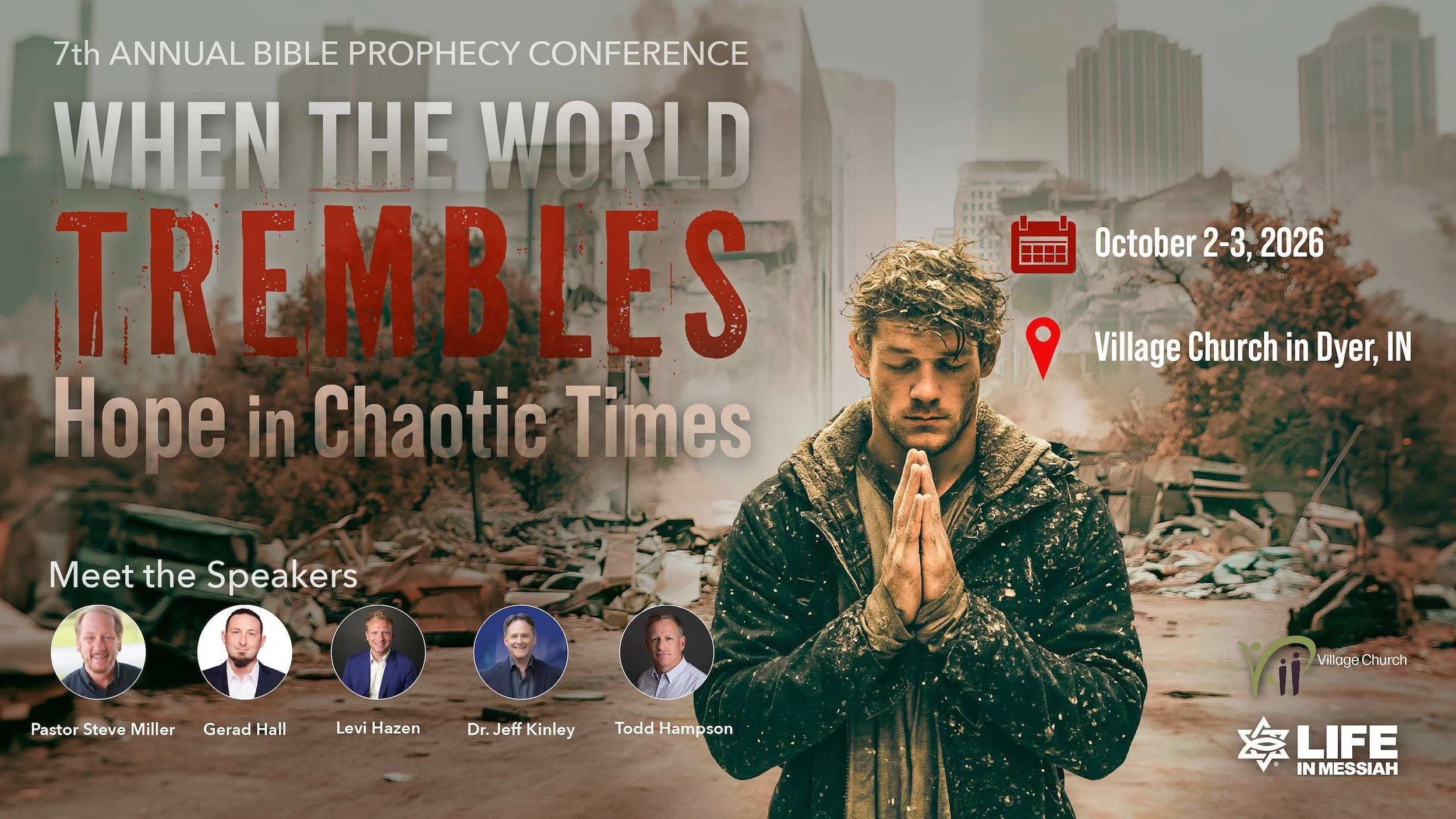
We invite you to join Life in Messiah for our upcoming prophecy conference – When the World Trembles: Hope in Chaotic Times, a powerful weekend of biblical teaching on prophecy and fellowship focused on God’s sovereign plan for Israel and the nations. Through engaging sessions led by respected scholars and ministry leaders, you'll gain clarity and encouragement as we explore what Scripture reveals about the days ahead. Click the link above for more information!
This blog post is adapted from an episode of The TŌV Podcast, recorded by Life in Messiah’s Executive Director, Levi Hazen. If you’d like to listen to the original episode – which goes into even greater depth – click HERE.
Does your understanding of biblical prophecy give you greater hope, or has it become a source of confusion? Why?
How does the Bible's record of fulfilled prophecy strengthen your trust in what God says about the future?
Are there areas where you've been tempted to focus more on current events than on God's unchanging Word?
Endnotes:
[1] Mark Hitchcock, The End: A Complete Overview of Bible Prophecy and the End of Days (Carol Stream, IL: Tyndale House Publishers, 2012), chap. 10; Mark Hitchcock, The Complete Book of Bible Prophecy (Eugene, OR: Harvest House Publishers, 2016), 17–19; Mark Hitchcock, The Amazing Claims of Bible Prophecy (Eugene, OR: Harvest House Publishers, 2013), 19–20. Citing prophecy scholar John F. Walvoord, Hitchcock writes that the Bible contains approximately 1,000 prophecies, about 500 of which have already been fulfilled, and observes that approximately 27 percent of Scripture is prophetic in nature.