

A Damaging Delusion
I am relieved that so-called “Pride Month” is behind us. Thankfully, the dip in corporate and government support was noticeable, as was previous years’ pressure to support and normalize the “Pride” worldview. People seem to be waking up. More states, schools and athletic organizations are preventing men from competing in women’s sports and invading female spaces in the name of transgenderism. It is a relief to see lawmakers step up to protect children from drugging and physical mutilation in the name of “gender affirming care.”
For Christians who take the Scriptures seriously and interpret them plainly, the pseudo-scientific assertion that gender is fluid is absurd. According to Genesis, God created humanity male and female, period! Each has his or her unique role and both are necessary for the propagation of mankind. Denying this fundamental reality is an affront to God’s “very good” creation. It also brings harm to God’s beloved creatures.
Proponents of transgenderism insist that one’s identity as male or female is not an objective reality but is based on a subjective sense of one’s true self. Encouraging people who are struggling with their identity to find relief in this fantasy does great harm, as evidenced by the higher rates of suicide and violence among its adherents.[1] It pushes already confused people to embrace delusional thinking and drives them further from their God-given identity and the peace only their loving Creator can provide. However, transgenderism is not the only dangerous twisting of God-ordained distinctions.
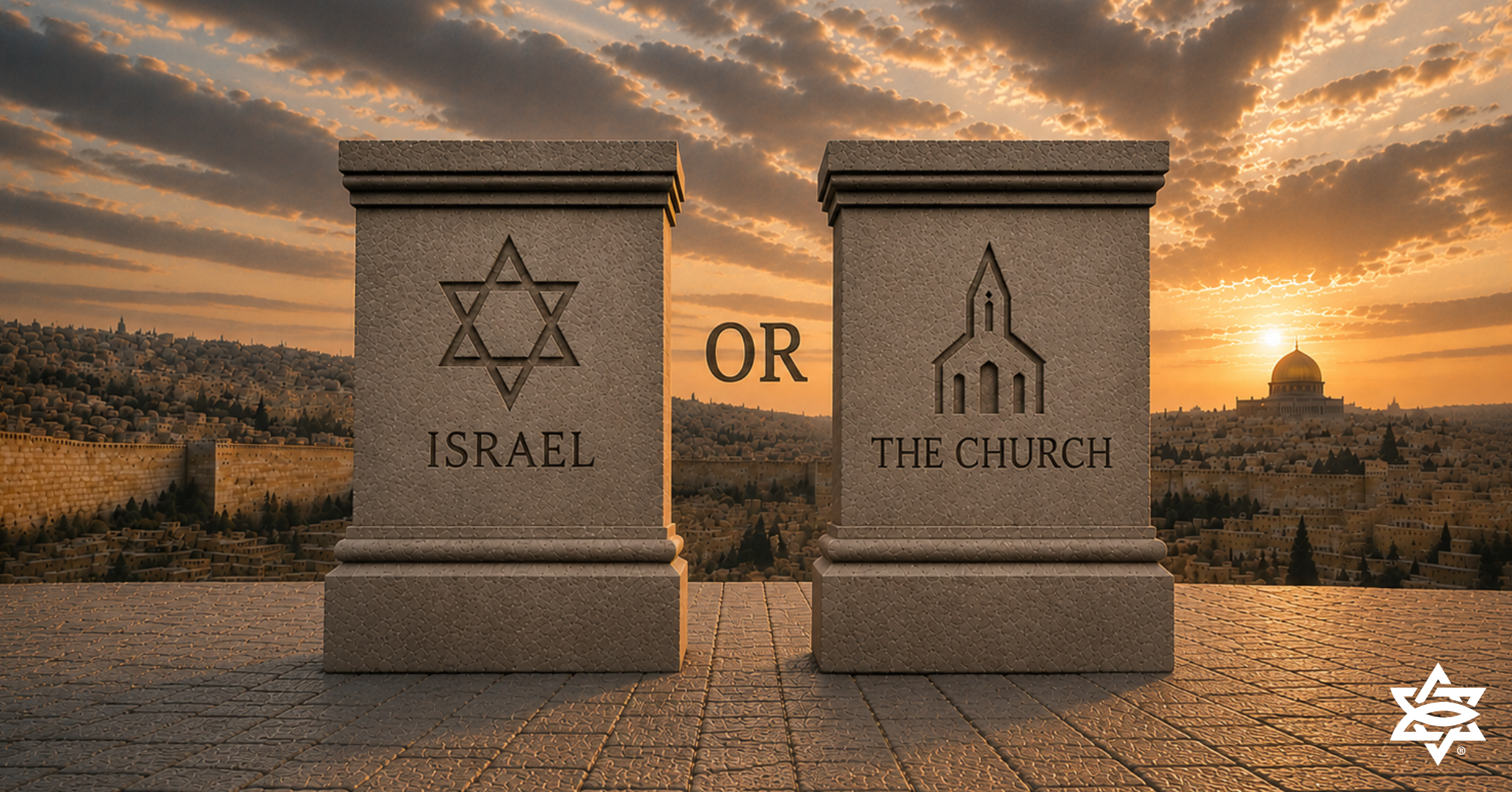
The absurdity and harm of transgenderism is a fitting analog to replacement (aka “supersessionist” or “fulfillment”) theology. One believes men can become women; the other believes the Church becomes Israel. Both take two distinct categories created by God and confuse them with destructive results.
Just as God created Eve from Adam’s side, so too God created Israel out from the rest of humanity by calling Abraham and making a great nation of his descendants. By God’s sovereign will for humanity, two distinct categories of people inhabit planet earth – Israel (Abraham’s descendants, the Jewish people) and Gentiles (the nations of the earth). Each is precious in God’s sight, yet each has its own role in God’s eternal redemptive plan.
Similarly, since Acts 2, God has been calling out the Church, Messiah’s body, which Paul describes in Ephesians 2 as comprised of believing Jews and Gentiles. According to Jesus’ instruction to His disciples, the call started in Jerusalem, then moved outward to Judea, Samaria, and to the remotest parts of the earth. Just as Eve found her source in Adam, so too the Church finds its source in Israel. And like Adam and Eve, and Jews and Gentiles, the Church and Israel have unique yet related God-given roles in world redemption.
A plain reading of Scripture reveals that God chose Abraham (Genesis 12) and entered into an unconditional covenant with him (Genesis 15). God committed Himself to do three things for Abraham and his progeny through Isaac, Jacob and Jacob’s sons: multiply their descendants, give them a land of their own, and to bless them and make them a blessing to the nations. God changed Jacob’s name to Israel, which became the name for the nation descended from Abraham.
In the Scriptures “Israel” means “Israel,” the nation God created through Abraham’s descendants, the Jewish people. At no point does God indicate this will ever change. Israel is Israel regardless of their obedience or disobedience to God.
Why is this the case? The Apostle Paul gives the definitive reason “for the gifts and the calling of God are irrevocable.” That Paul is referring to the Jewish people is evident because he is addressing Israel’s unbelief and rejection of Jesus as the Messiah. Furthermore, Paul highlights God’s preservation of a believing remnant in Elijah’s day to affirm God’s preservation of the same within Israel in Paul’s day.
An early form of this error was already forming in the church of Rome. In response, Paul labors to alleviate their ignorance and reliance on human wisdom. He points them to the mystery of God’s plan, “For I do not want you, brethren, to be uninformed of this mystery –so that you will not be wise in your own estimation – that a partial hardening has happened to Israel until the fullness of the Gentiles has come in.” The existence of the believing remnant and the temporary nature of Israel’s hardening clearly confirm Israel’s ongoing place in God’s plan.
Tragically, Paul’s warning was ignored. Supersessionist doctrine took root and was passionately nurtured by church fathers, Constantine, church councils, popes, and sadly added to the list, Reformation saints. Generations of Christians have been taught that God rejected Israel due to their rejection of Jesus, and that Israel’s role and God’s blessings now reside in the Church. Ironically, the same error exists in some form in the doctrine of Christian cults such as Jehovah’s Witnesses and the Church of Latter-Day Saints!
Insisting that the Church can become Israel is a damaging delusion, like that of transgenderism. The assumption of God’s rejection of Israel and their replacement by the Church led to millennia of persecution of Jews by those claiming Jesus as Lord. It fueled the church’s insistence that any Jew who confessed faith in Jesus had to repudiate his Jewish identity and sever all ties with the Jewish community. The Jewishness of Jesus and the gospel message were officially repudiated by the church resulting in unimaginable impediments to effective gospel proclamation within the Jewish community. Tragically, this evil doctrine persists to this very moment and is used to question or outright deny the Jewish people’s right to their God-given land, as well as to fuel anti-Jewish sentiment in Messiah’s body.
More than ever the Church needs loving voices calling it to recognize the absurdity and destructiveness of replacement theology. Let us arm ourselves with a biblical appreciation for God’s plan. We encourage you to use Life in Messiah’s many resources[2] to equip yourself to help our brothers and sisters in Messiah Jesus appreciate the God-ordained distinction between Israel and the church – how each is cherished by God and has an essential role in carrying out God’s purposes for God’s glory.
“I say then, God has not rejected His people, has He? May it never be! For I too am an Israelite, a descendant of Abraham, of the tribe of Benjamin. God has not rejected His people whom He foreknew” (Romans 11:1-2a).
Written by Dan, Life in Messiah Board Member
What happens when God-given identities are redefined by human reasoning?
What are the practical consequences of believing that the Church has replaced Israel – or not? How does this view shape attitudes toward the modern state of Israel and Jewish people?
Am I willing to follow Scripture wherever it leads, even if it challenges my tradition?
Endnotes:
[1] See Brae Anne McArthur et al., "Suicidality and Nonsuicidal Self-Injury in Transgender and Gender Diverse Youth: A Systematic Review and Meta-Analysis," JAMA Pediatrics 180, no. 2 (2026): 144–151, https://jamanetwork.com/journals/jamapediatrics/fullarticle/2842556; Amery Strauss et al., "Suicidal Thoughts and Behaviors Among Transgender Adolescents: A Systematic Review," Child and Adolescent Psychiatry and Mental Health 17 (2023), https://link.springer.com/article/10.1186/s13034-023-00654-3; and Centers for Disease Control and Prevention, "Disparities in Health Outcomes Among Transgender and Cisgender Students—Youth Risk Behavior Survey, United States, 2023," Morbidity and Mortality Weekly Report 73, suppl. 4 (2024), https://www.cdc.gov/mmwr/volumes/73/su/su7304a6.htm.
[2] For further study on the biblical distinction between Israel and the Church, see Life in Messiah’s learning resources, including Why Jewish Ministry? and The TŌV Podcast episode Distinctions Between the Covenants. Additional resources on Jewish ministry, biblical prophecy, and the Jewish roots of the Christian faith are available through Life in Messiah's Learning Portal and our Resources page (which includes our publications as well).