
The Book of Moses
Have you ever begun to read the Bible with full intention to read it “from cover to cover”? As often happens with resolutions, it’s easy to get derailed before reaching the goal. For some, the first list of genealogies that interrupts the narrative is a mountain too high to scale. So, we may opt to speedread (or skip altogether) Genesis 10.
By Genesis 12 we are reading about God’s call of Abram/Abraham[1] and the promise of land, a great nation, and global blessing. Plot twists are interwoven with the stories of Sarah and Hagar, Ishmael and Isaac; then come Isaac's twins, Esau and Jacob/Israel,[2] whose sons will form the 12 tribes of Israel. The arc of his son Joseph’s story – betrayed by his brothers, enslaved, imprisoned, and choosing to save his brothers after being elevated to power – brings Genesis to a fascinating conclusion.
The story picks up in Exodus with Abraham’s now greatly enlarged family enslaved in Egypt (as God foretold in Genesis 15!). Moses becomes the central character and his story is sufficiently riveting for Hollywood to make blockbuster movies like “The Ten Commandments” and “Prince of Egypt.” Dramatic scenes abound: 10 plagues, crossing the parted waters of the Red/Reed Sea,[3] Moses ascending Mt. Sinai to receive the tablets etched by the finger of God, and Israel’s worship of the golden calf.
If we persevere (perhaps following a daily reading plan) we feel pretty good about completing Exodus. But our motivation may take a big hit as we open Leviticus with Israel still at Mt. Sinai. If any of Moses’ writings deserve to be called a law book, it is Leviticus with its emphasis on holiness. God’s detailed commands to His adopted nation continue; the first 16 chapters focus on proper worship of the LORD. Here we find the instruction manual for Israel’s priests and Levites regarding the multi-layered sacrificial system, including the Day of Atonement (ch. 16).
The last 11 chapters give details for living a holy, separated life as members of God’s chosen people. The rules cover a wide range for living in community as well as personal purity, including kosher foods and Sabbath/holy day requirements. Blessings for obedience and curses for disobedience are clearly stated.[4] It can be easy to lose the plot line in all the details….
But wait – there’s more to the compelling story (albeit filled with loads of details)! The Hebrew title of Numbers is Bemidbar[5] – “in the desert.” The Hebrews depart Mt. Sinai (10:33) and begin moving through the wilderness. Three major themes are detailed: how Israel was to order itself in its travels post-Sinai; how the priests and Levites were to manage the Tent of Meeting and all its equipment during those travels; and preparation for conquering and settling the land west of the Jordan.
Included in the Numbers narrative are notable conflicts, including Miriam and Aaron’s challenging Moses’s leadership (Numbers 12) as well as Korah’s rebellion (ch. 15). The people failed to believe Joshua and Caleb when the other 10 spies gave a negative report (chs. 13–14). The prophecies of Balaam are noteworthy, as God turns intended curses against Israel into blessings, including affirmation of Judah’s royal rule (24:17). God selects Joshua to succeed Moses (ch. 27) and two-and-a-half tribes possess territory east of the Jordan (ch. 32).
Whew! That’s a lot of history to work through. But we have one more “Torah hill” to climb: the Book of Deuteronomy.[6] The Hebrew title D’varim literally means “words”: “These are the words which Moses spoke to all Israel across the Jordan in the wilderness….”
While some of the previously recorded instructions received at Mt. Sinai are rehearsed, Deuteronomy is more a pastoral and legal exposition of the Torah for a new generation on the verge of (finally!) entering Canaan. Well over half of Deuteronomy's legal material is either new, expanded upon, or stated differently, rather than rehearsed. Included are instructions for worship, rules for kings, judicial requirements (e.g., two witnesses), military guidelines, and laws regarding the economy and family (including divorce).
Deuteronomy functions as a covenant-renewal document for the next generation on the plains of Moab. The concluding five chapters focus on the transition of leadership to Joshua, reinforcing the importance of knowing and adhering to God’s instructions. Moses teaches Israel a final song (chs. 31–32) and gives his final blessing (ch. 33) before his death is recorded (ch. 34).
The Torah is comprised of five books. The Greek word for them is Pentateuch (penta = five).[7] However, modern scholarship acknowledges the Torah should be considered as one interrelated book with five major divisions. The Torah/Pentateuch can rightly be called “the book of Moses.”[8] For example, Ezra reads from “the book of Moses” when the Israelites return from captivity (Ezra 6:18; Nehemiah 13:1).
Torah is most often understood to mean “law.” However, the Hebrew word תּוֹרָה (Torah) means "instruction" or "teaching”;[9] the broader sense is God's instruction for His people. Hebrew vocabulary has a rich treasure chest of words related to laws, rules, and regulations.[10] While the Torah indeed contains a law code, it primarily is the narrative story of God’s dealings with His creation and most especially, the people He uniquely chose from among the nations.[11]
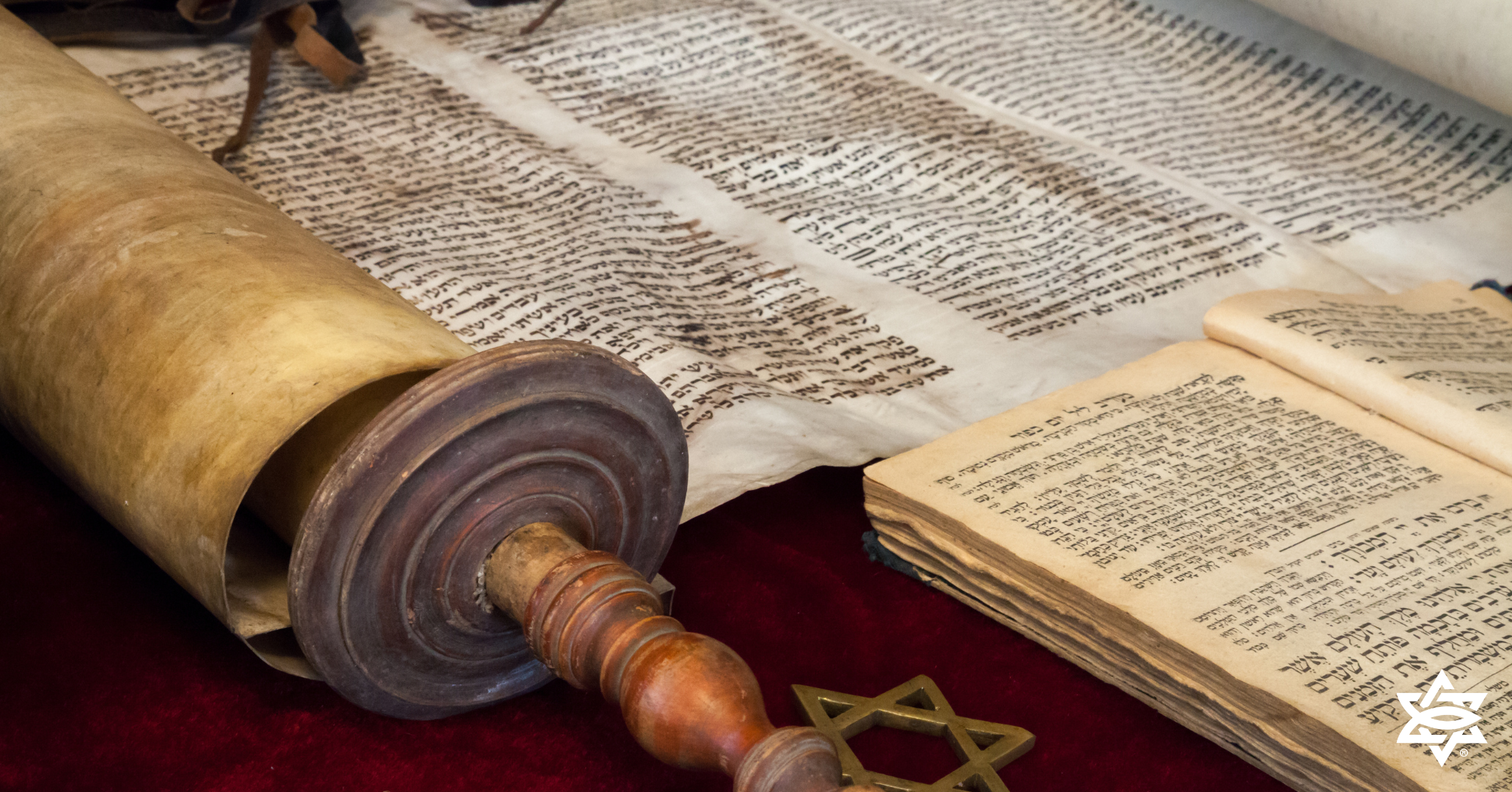
For those who grew up going to shul (synagogue), the Torah literally is an “opened scroll.” Each Shabbat the Torah is unrolled to the weekly parsha (annual Torah-reading cycle portion) and the same prescribed text is read in synagogues around the world. To demonstrate there is no end to reading the Torah, on Simchat Torah[12] the last verses of Deuteronomy 34 are read; then the scroll is rolled back and the first verses of Genesis are intoned.
In many Christian churches the Old Testament is largely neglected, which is beyond sad. When Paul wrote “All Scripture is inspired by God” (2 Timothy 3:16), the New Testament was still being written; the Hebrew Scriptures were the only Bible of the early church. That Jesus’ disciples knew it well is evidenced by how often they referenced it. In fact, four of the top six books of the Tanakh (Old Testament) quoted in the New Testament are in the Torah.[13]
In quoting from the Hebrew Scriptures, the New Testament writers were following their Master’s example. That Yeshua most often cites Deuteronomy[14] should indicate the value of the Torah in informing life. As a prime example, in the Matthew 4 record of His temptation in the wilderness, the Lord answers each of Satan’s three invitations to act in His own self-interest with quotes from Deuteronomy. When asked what constitutes the greatest commandment, Yeshua quoted Deuteronomy 6:4-5.[15]
Post-resurrection, on the road to Emmaus Yeshua gave Cleopas and another disciple a master class on Messianic prophecy. “Then beginning with Moses and with all the Prophets, He explained to them the things written about Himself in all the Scriptures” (Luke 24:27).
Judaism continues to look back to the receiving of Torah at Mt. Sinai as the apex of history, with Moses remaining the most revered character to this day. As followers of Messiah Jesus, we look back to Mt. Calvary and the empty tomb as the penultimate apex of history with Yeshua fulfilling the promise of “the prophet greater than Moses.” And we await the fulfillment of His ascending to David’s throne in the Kingdom yet to come.
In the meantime, may we continue to mine the rich treasures found in our Bibles. And may we learn to plumb the depths of God’s instruction in the Old Testament so we may rightly interpret the New. God’s covenant faithfulness shines through – and should encourage our hearts amidst the challenges of living a life of faith.
Written by Wes Taber, Life in Messiah Global Ambassador
In rising to the challenge of reading through the Bible, what obstacles or hindrances do you face?
What Old Testament passages do you find yourself returning to most often?
For insight on the weekly parsha, see https://www.insearchofshalom.com/parshot/.
Endnotes:
[1] God changes Abram’s “exalted father” name to Abraham (“father of many”) in Genesis 17:4–5.
[2] After wrestling with the angel in Genesis 32, Jacob is renamed Israel. Abraham and his descendants were called Hebrews; with Jacob's name change, his descendants formed the people/nation of Israel.
After the nation divided into two, the northern 10 tribes retained the name Israel while Judah and Benjamin's territory (which included Jerusalem) was called Judea. The term “Jew" is derived from “Judean.”
Today, wherever they live in the world, Jacob's offspring are “Jews”; anyone holding citizenship in Israel is “Israeli," including Israeli Arabs. Thus “Jewish" is ethnicity; “Israeli" is nationality.
[3] Yam Suph literally is “Reed Sea” in Hebrew. The Septuagint (or LXX, the second century BC Greek translation of the Old Testament) changed it to Erythra Thalassa, Red Sea; theories abound as to why.
[4] The list of blessings for obedience and curses for disobedience has been compared with ancient “suzerainty treaties” wherein rulers stipulate what is required of their subjects, including rewards for obedience and consequences for violating the terms.
[5] Genesis is named for the first word in the text, Bereshit (Beh-reh-sheet): “In the beginning.” Exodus is Shemot, the Hebrew word for “Names,” as the narrative begins “These are the names of the sons of Israel….” Leviticus derives from the Septuagint name Leviticon (“pertaining to the Levites, an apt name for the contents). The Hebrew name is Vayikra, (“And He [the LORD] called”), the book's opening word.
[6] The Septuagint’s title Deuteronomion/δευτερονόμιον (deutero "second” plus nomos “law" or "repetition of the law") was adopted by translators. The Wycliffe Bible (1382) spelled it Deuteronomie; Tyndale’s 1526 translation has the spelling English Bibles use today.
[7] In Hebrew, the five books are referred to as the Chumash (chamesh = five).
[8] Likely Joshua (or another inspired editor) wrote the account of Moses' death in Deuteronomy 34.
[9] The root word yarah relates to pointing the way, giving direction.
[10] Psalm 119 illustrates the spectrum of vocabulary related to “law”:
· תּוֹרָה Torah = Instruction
· מִצְוֹת Mitzvot = Commandments
· חֻקִּים Ḥukkim = Statutes
· מִשְׁפָּטִים Mishpatim = Judgments/Ordinances
· פִּקּוּדִים Pikkudim = Precepts
· עֵדוֹת Edot = Testimonies
· דָּבָר D’var(im) = Word(s)
· אִמְרָה Imrah = Spoken word/promise
[11] To see the special connection of the Torah to Israel, and God’s purpose in giving it to them, see Deuteronomy 4. For confirmation that God chose Israel to be His unique treasured possession, see Deuteronomy 7:6-11.
[12] In Israel, a “bonus day” is added to the week-long Sukkot festival, followed by Simchat Torah. Outside Israel, Simchat Torah is celebrated right after Sukkot ends. In 2026, Simchat Torah fell on Sunday, October 4 in the diaspora.
[13] In the New Testament, Psalms are the most quoted (79x); Isaiah is next (68). The “Book of Moses” referenced in order of occurrence: Deuteronomy (50), Genesis (45), Exodus (39), and Leviticus (17).
[14] Jesus quotes or alludes to Deuteronomy 20 times; the Psalms and Isaiah 15 times each.
[15] These are the most quoted verses in Judaism, beginning with the Shema: “Hear O Israel, the Lord is our God, the Lord is one” (6:4). Recited in both the morning (Shacharit) and evening (Ma’ariv) prayers, the Shema is also written on the parchment scroll (mezuzah) posted on the doorposts of Jewish edifices.